
Online lists often put the German Shepherd bite force at about 238 PSI. That figure works as a rough internet reference, not a fixed scientific breed average. Peer-reviewed studies usually report canine bite force in Newtons instead of PSI. The difference matters because force and pressure measure different things.
Short answer: Researchers have not established one definitive PSI value for this breed. A 2021 police-dog study reported a median bite force of 360.4 N for six usable GSD trials. You cannot convert that result to PSI without knowing tooth-contact area, so 238 PSI should remain an estimate.
| Key fact | Best-supported answer |
|---|---|
| Common online figure | About 238 PSI, but not a standardized scientific breed average |
| Direct measured result | 360.4 N median in six usable GSD bite-force trials |
| Same-study Malinois result | 247.0 N median; the breed difference was not statistically significant |
| Why results vary | Method, size, motivation, bite location, sensor design, and contact area matter |
| What the number means | Jaw strength does not predict temperament or whether an individual dog will bite |
The measured figures above come from a sensor-equipped police-dog study. The uncertainty around fixed PSI values is also reflected in veterinary research on canine bite-force measurement.
TL;DR: Key Takeaways
- 238 PSI is widely repeated online, but it is not a settled scientific breed standard.
- A 2021 study measured a median of 360.4 N in six usable GSD bite-force trials.
- Newtons measure force, while PSI measures pressure across a known area.
- Same-method comparisons are more useful than breed rankings built from mixed sources.
- Training, socialization, supervision, and medical response matter more than one jaw-strength number.
German Shepherd Bite Force: What the Research Actually Measured
The strongest direct evidence comes from a 2021 study of Finnish police dogs. Researchers fitted a protective bite sleeve with three force sensors. The dogs ran 25 meters, then bit the sleeve during a modified working exercise.
Seven GSDs and thirteen Malinois entered the study. We excluded one GSD and one Malinois dataset because their bite-force data were corrupted. The remaining groups produced medians of 360.4 N and 247.0 N, respectively.
The difference between breeds was not statistically significant in that small sample. The sleeve showed moderate-to-good test-retest reliability. That makes the result useful, but not a universal number for every pet or working dog.
Why 238 PSI Keeps Appearing Online
The 238 PSI figure appears across pet sites, breed pages, and legal websites. Yet peer-reviewed studies reviewed here do not establish 238 PSI as a definitive average. Recent veterinary-reviewed coverage also warns that many precise online PSI values lack clear research support.
PSI means pounds per square inch, a measure of pressure across an area. Newtons measure force without describing that contact area. A Newton value becomes PSI only when you know the biting area.
That distinction explains why simple conversions can mislead readers. Tooth position, sensor shape, and contact area can change a pressure estimate. Treat breed-specific PSI tables as rough references, not laboratory standards.
What Changes How Hard a Dog Can Bite
Bite strength is not a single setting that every dog reaches on command. Veterinary research shows wide variation between dogs and testing conditions. A major review also found that a dog’s willingness to bite a sensor can affect readings.
| Factor | Why it changes the measurement |
|---|---|
| Body size and jaw dimensions | Larger dogs can generate different forces, although size does not explain every result |
| Motivation | A dog may bite a toy, sensor, sleeve, or perceived threat with different effort |
| Bite location | Front and rear teeth do not apply force through identical mechanics |
| Measurement tool | Sleeves, bars, models, and other devices produce different kinds of data |
| Contact area | Pressure depends on how force spreads across the bitten surface |
| Training and context | Working exercises differ from play, chewing, fear, pain, or defensive behavior |
A classic pilot study illustrates variation across ordinary dogs. Researchers used a rawhide-covered transducer to record 13 to 1,394 N from 22 pets. The dogs’ willingness to chew the device influenced the measurements.
How the Breed Compares With a Belgian Malinois
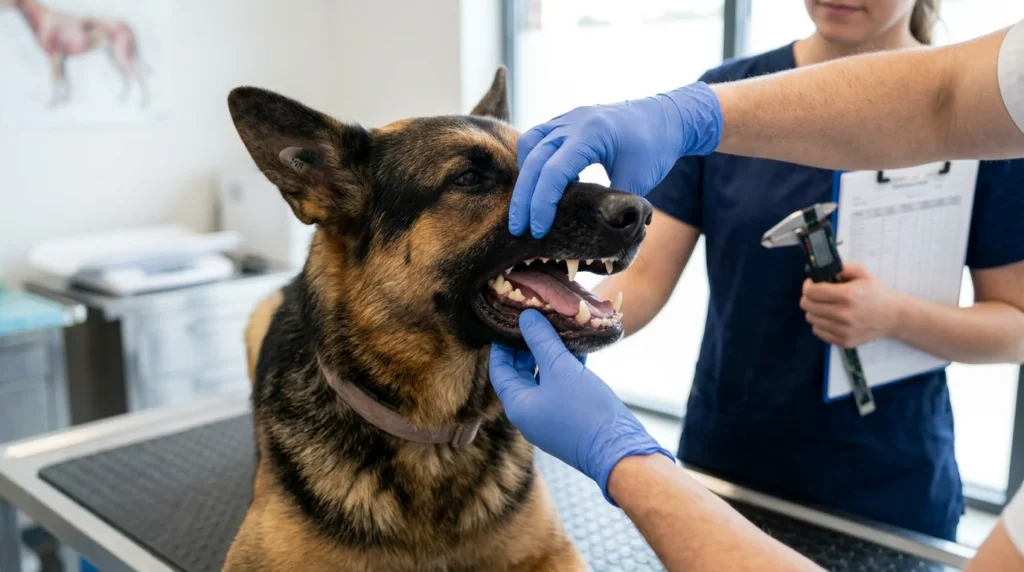
Same-study comparisons are more useful than mixing unrelated PSI charts. The 2021 police-dog study measured both breeds with the same instrument and task. GSDs showed a higher median, while Malinois showed a lower median.
That result does not prove GSDs always bite harder. Small samples, working selection, sex, and motivation limit broad conclusions. The study also found no statistically significant bite-force difference between those breed groups.
Online comparisons often rank Rottweilers, pit bulls, and other breeds by PSI. Those lists commonly combine different methods, estimates, or unsourced values. A fair comparison needs the same equipment, task, tooth position, and study conditions.
Bite Force Does Not Equal Aggression
The American Kennel Club describes the breed as loyal, confident, courageous, and steady. The German Shepherd Dog Club of America standard calls for fearless behavior without hostility. That standard also disqualifies dogs that attempt to bite a judge.
A strong jaw gives a dog physical capacity, not a behavioral destiny. Fear, pain, guarding, handling, and learned behavior can all influence bite risk. Good management focuses on behavior before physical strength becomes relevant.
For more animal-care coverage, browse the Readslife Pets section. Its guides focus on practical household pet questions. That broader context is more useful than judging any dog by one number.
How Owners Can Reduce Bite Risk
Start with early, positive socialization and consistent reward-based training. Teach calm handling, reliable recall, and simple cues before stressful situations develop. Never test jaw strength at home or encourage a dog to bite people.
Supervise children around dogs, including familiar family pets. Give dogs space when they are eating, sleeping, injured, frightened, or caring for puppies. Use secure leashes and barriers when visitors or unfamiliar animals create stress.
If a dog begins growling, snapping, or showing sudden behavior changes, contact a veterinarian first. Pain and illness can change behavior, so medical causes deserve attention. A qualified trainer or veterinary behavior professional can then help with a safer plan.
Household pet safety also depends on context, not simple labels. Readslife’s rosemary safety guide for cats shows why product form and exposure level matter. The same careful thinking helps owners avoid oversimplified claims about canine behavior.
What to Do After a Dog Bite in the United States
If skin is broken, wash the wound thoroughly with soap and water. CDC guidance says deep wounds need pressure with a clean, dry cloth. Seek prompt medical care for serious wounds, uncontrolled bleeding, severe pain, or lost function.
A clinician can assess infection risk, tetanus status, and possible rabies exposure. Rabies decisions depend on the animal, vaccination status, location, and public-health guidance. CDC advises reporting bites when vaccination status is unknown or the animal appears sick.
Readslife’s Health section can help with broader wellness topics. It should not replace medical care after a serious bite. Use CDC guidance or your local health department for current U.S. rabies decisions.
Why Working Dogs Are More Than Jaw Strength
German Shepherds have long served in police, military, search, rescue, and assistance roles. AKC sources emphasize intelligence, trainability, courage, and close handler relationships. Working performance depends on control and reliability, not jaw strength alone.
A working dog’s value is not its maximum bite pressure. Handlers need dependable responses, stable behavior, stamina, and clear communication under stress. Bite-force trivia tells only a small part of the breed’s working story.
Frequently Asked Questions
What is the German Shepherd bite force in PSI?
About 238 PSI is the most repeated online figure. It should be treated as an estimate, not a scientifically fixed breed average. The best direct study reviewed here reported 360.4 N, which cannot be converted to a PSI value without a known contact area.
Can a German Shepherd bite break a bone?
A severe dog bite can cause deep wounds, crush injuries, and fractures. Injury depends on location, bite duration, movement, victim size, and many other factors. Deep bites, severe pain, heavy bleeding, or lost function need prompt medical evaluation.
Do German Shepherds have locking jaws?
No recognized locking-jaw mechanism is unique to this breed. Dogs can maintain a strong grip through muscle action and behavior. That ability is not a mechanical jaw lock.
Does a Malinois bite harder than a German Shepherd?
The 2021 same-method study found a lower Malinois median than the GSD median. That breed difference was not statistically significant in the small sample. The result cannot establish a universal winner between the breeds.
Should I test my dog’s bite strength at home?
No, home bite-force testing can injure you or your dog. It can also create unsafe handling situations without producing reliable scientific data. Leave specialized working-dog exercises to qualified professionals using proper equipment.
The Bottom Line
The most defensible answer is not one fixed PSI number. A direct study measured a 360.4 N median across six usable GSD bite-force records. The popular 238 PSI estimate needs a clear uncertainty label whenever it appears.
For owners, behavior matters more than internet rankings. Train consistently, supervise wisely, and respond early to fear, pain, or behavior changes. If a bite breaks skin, follow current CDC guidance and seek medical care when indicated.
Keep exploring Readslife for practical pet and health information. Use measured research when a viral number sounds unusually precise. That habit protects readers from repeating claims that science has not firmly established.