

Crossing a quiet street halfway down the block may seem harmless, but the legal answer can change from one city to another. The everyday label covers several pedestrian rules, so it helps to separate the common meaning from the actual traffic code.
Direct answer: What is jaywalking? It generally means crossing or using a roadway in a way that violates local pedestrian rules, such as crossing against a signal or outside a required crosswalk. What counts as a violation is not the same everywhere because states and cities write and enforce pedestrian laws differently.
| Key question | Quick answer |
| What does the term mean? | Crossing a street illegally, carelessly, or against pedestrian traffic rules |
| What are common examples? | Ignoring signals, improper mid-block crossing, or entering roads closed to pedestrians |
| Is it illegal everywhere? | No. State and local rules differ. |
| Can you get fined? | Yes, where the underlying pedestrian violation is enforceable |
| Is every mid-block crossing illegal? | No. It depends on the location and circumstances. |
What Is Jaywalking Under Traffic Laws?
Most traffic codes regulate specific pedestrian actions rather than using the slang word itself. Cornell’s Legal Information Institute describes the conduct as illegally crossing a street and notes that the rules and severity vary among jurisdictions. That distinction matters. Crossing between intersections may be permitted on one street but restricted on another.
Rules can depend on nearby traffic signals, crosswalks, road design, and the pedestrian’s duty to yield. For a legal answer in a specific place, check the current state vehicle code and municipal rules rather than relying only on the familiar label. Readers can also browse Readslife’s Law section for related legal explainers.
What Actions Commonly Count?
People often use jaywalking to describe several types of improper pedestrian movement. Common examples include:
- Crossing against a pedestrian signal where the law requires you to obey it.
- Crossing mid-block where a local rule requires the use of a crosswalk.
- Crossing diagonally through an intersection when that movement is prohibited.
- Walking onto a freeway, bridge, or other roadway where pedestrians are not permitted.
Legal guides give similar examples, including crossing against a signal, improper mid-block crossing, and walking on roads where pedestrian traffic is prohibited.
Simply crossing outside painted lines does not automatically constitute a violation. Unmarked crosswalks and location-specific rules can change the answer.
Is Jaywalking Illegal Everywhere?
No. Pedestrian law is not uniform across the United States. Recent changes in California and New York City show how different the rules can be.
| Location | Current rule | Practical effect |
| California | Crosswalk use is still required between adjacent signal-controlled intersections in specified situations. | Police generally cannot stop a pedestrian for that violation unless the crossing creates an immediate collision danger. |
| New York City | Local Law 98 permits crossing outside crosswalks and against traffic signals. | NYC rules were amended to decriminalize jaywalking. |
| Other U.S. locations | State and municipal pedestrian codes differ. | You need to check the law where you are. |
California Vehicle Code Section 21955 keeps certain crosswalk requirements but limits police stops unless an immediate collision or danger exists. The statute also preserves duties of care for both pedestrians and drivers.
New York City took a different approach. Local Law 98 was enacted on October 26, 2024. It allows pedestrians to cross outside crosswalks and against traffic signals without violating the city administrative code. NYC DOT then adopted matching rules that took effect on June 26, 2025. These examples also serve as a reminder that an old article about pedestrian law may no longer reflect current enforcement.
Can You Get a Ticket or Fine?
A jaywalking citation can still be issued where the underlying pedestrian conduct is prohibited and enforceable. Cornell notes that the classification varies by jurisdiction. A violation may be treated as an infraction in one place and more seriously in another. Fines and enforcement practices also differ. There is no single nationwide fine. Before relying on a number found online, check the current traffic code, court schedule, or transportation department for that location.
Does Improper Crossing Affect Fault After a Crash?
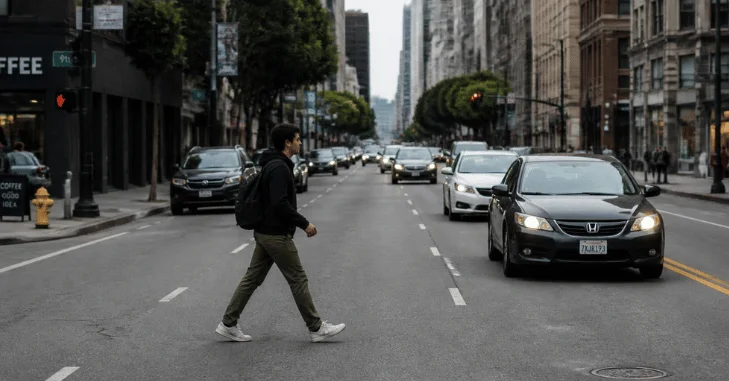
Jaywalking can affect fault after a pedestrian collision, but it does not automatically make the driver blameless. An improper crossing may lead to shared fault when it contributes to an accident. The result depends on the facts and the negligence rules used by that state.
Drivers can still have duties toward people in the roadway. California law, for example, expressly states that its pedestrian-crossing provisions do not remove a driver’s duty to exercise due care for pedestrian safety. If a collision occurs, details such as traffic signals, visibility, vehicle speed, witness accounts, and photographs may become important. Readslife’s crash-response checklist for a car accident covers useful steps for documenting a crash scene. This section provides general information, not legal advice about a particular accident.
Why Is It Called Jaywalking?
The name “jaywalking” has nothing to do with walking in the shape of the letter “J.” Merriam-Webster traces the expression to the early 1900s. “Jaywalker” developed from the older term “jay-driver,” which described someone who drove improperly. At the time, “jay” could describe an inexperienced or unsophisticated person. Early written evidence points to Kansas.
The meaning later became associated with careless or illegal street crossing. That history helps explain why the word is more of a cultural label than a precise legal category.
Safe Crossing Matters Even Where the Law Is Flexible
The legal status of a crossing is only one issue. Traffic safety matters regardless of whether a city issues pedestrian tickets. NHTSA’s pedestrian safety data records that 7,080 pedestrians were killed and 71,635 were injured in U.S. traffic crashes during 2024. On average, a pedestrian was killed every 74 minutes.
NHTSA advises pedestrians to use crosswalks when they are available and to obey traffic signs and signals. If no crosswalk is available, it recommends choosing a well-lit location where drivers can see you. Watch for turning vehicles, avoid stepping suddenly into moving traffic, and make sure you have enough time to finish the crossing. A legal crossing can still be risky if drivers cannot see you. For more practical explainers about law and other everyday topics, browse Readslife’s Education guides.
Know the Local Rule Before You Cross
Do not assume every mid-block crossing is illegal. At the same time, decriminalization does not make every crossing safe. Check current pedestrian rules if you are unsure, especially when traveling in an unfamiliar city. Use signals and crosswalks when available, stay visible, and give yourself enough time to cross without entering the path of moving traffic. You might also like Is Rosemary Safe For Cats.
Frequently Asked Questions
It means crossing or using a street in a way that violates an applicable pedestrian rule or is considered careless or unsafe. The precise legal definition depends on local law.
No. Some jurisdictions restrict mid-block crossing only in certain locations. Other rules require pedestrians outside a crosswalk to yield to nearby traffic. Check the law that applies to the road you are using.
New York City no longer makes crossing outside a crosswalk or against a traffic signal a city-code violation subject to a summons. Local Law 98 was enacted in 2024, and NYC DOT’s matching rule took effect on June 26, 2025.
It can. A pedestrian’s conduct may be considered if it contributed to a collision. Driver behavior also matters, and the effect on compensation depends on the state’s negligence law and the evidence.